

Yes — a properly sized fire pit provides meaningful radiant heat for outdoor patio spaces. A standard gas fire pit outputs 40,000–100,000 BTU, comfortably warming 6–10 people seated within 6–8 feet of the fire. The effective heating radius is 6–10 feet from the fire face. Beyond that, radiant heat diminishes significantly. Wood-burning fire pits can exceed 100,000 BTU and produce more visible flame and heat — but require active fire management. In Utah’s climate, a fire pit extends comfortable outdoor season from approximately 6 months to 9–10 months.
How Fire Pit Heat Actually Works
A fire pit doesn’t heat the air the way a furnace heats a room. It produces radiant heat — infrared radiation that warms solid objects (people, furniture, patio surfaces) directly, without first heating the surrounding air.
This is an important distinction because:
- Radiant heat feels significantly warmer than air temperature suggests — you can feel comfortable at 40°F next to a well-established fire pit even though the ambient temperature hasn’t changed
- Radiant heat diminishes rapidly with distance — the inverse square law means twice the distance from the fire means roughly 1/4 the radiant heat received
- Wind disrupts radiant heat very little but affects convective warmth (the warm air rising from the fire) significantly — fire pit placement and windbreak design matter
Gas Fire Pit vs. Wood-Burning: Heat Output Comparison
Gas Fire Pits: 40,000–150,000 BTU
Gas fire pits are by far the most popular fire feature in Utah residential outdoor spaces. They offer:
Stunning Outdoor Spaces in Utah! 🌿✨
At Chopper Landscaping, we design and build stunning, functional outdoor spaces. From hardscapes to outdoor lighting and kitchens, we bring your vision to life.
Controlled output: Turn a dial, set the flame height, and the output stays consistent until you adjust it. No wood management, no fluctuating heat output.
Clean start and stop: No smoke accumulation (important for covered patio areas or pergolas), no ash cleanup, no ember management.
Stunning Outdoor Spaces in Utah! 🌿✨
At Chopper Landscaping, we design and build stunning, functional outdoor spaces. From hardscapes to outdoor lighting and kitchens, we bring your vision to life.
Availability for Utah burn restriction days: On days when Utah issues air quality alerts that restrict wood burning, gas fire pits are typically not restricted under the same rules.
BTU specifics:
- Small table-top gas fire bowl (12–18 inch): 20,000–40,000 BTU — decorative warmth, not significant heating
- Standard built-in gas fire pit (24–36 inch round burner): 50,000–80,000 BTU — comfortable heating for 6–8 people at 5–7 feet
- Premium linear gas fire feature (36–60 inch linear burner): 80,000–150,000 BTU — effective heating for 8–12 people
For most Utah entertaining patios, a built-in gas fire pit with 60,000–80,000 BTU output at a properly designed seating distance (6–8 feet) is the sweet spot — enough heat to be genuinely warm without being overwhelming on mild evenings.
Wood-Burning Fire Pits: Variable but High Peak Output
Wood-burning fire pits produce highly variable heat output depending on wood type, fuel load, and combustion state. A well-established hardwood fire (oak, maple, ash) can easily exceed 100,000 BTU and produces an intense, radiant heat that many people find more satisfying than gas.
The tradeoffs:
- Active management required — adding wood, adjusting airflow, managing ember spread
- Smoke production (varying with wind direction and wood moisture content)
- Restricted on Utah air quality action days
- Cannot be used under covered patio structures without significant safety clearance
- Ash cleanup required after each use
Wood-burning fire pits are the right choice for homeowners who enjoy the ritual and ambiance of the fire as part of the experience. They are not the right choice for homeowners who want to turn the fire on from a phone app and forget about it.
Many Utah homeowners choose both: a gas fire feature as the primary entertaining fire (convenient, consistent) and a separate wood-burning fire bowl or fire pit for special occasions when the campfire experience is the point.
Utah Climate Context: Why Fire Features Matter More Here
Utah’s outdoor season without a fire feature runs approximately late May through early September — about 4 months of reliably comfortable evening temperatures. With a fire feature, that extends to:
- March–April: A good fire pit makes 40–50°F evenings comfortable
- May–October: No fire needed most evenings, but the pit provides ambiance
- October–November: Fire essential for comfortable outdoor use at 35–50°F
- December–February: Below 30°F — fire pits provide warmth but cannot compensate for extreme cold without wind protection
Net result: A well-positioned fire feature can double the comfortable outdoor entertaining season for Utah homeowners — from approximately 4 months to 8–9 months.
What Affects Fire Pit Warmth on Your Patio
Seating Distance
The most important variable. The effective heat zone for most fire pits is 4–8 feet from the fire face. Seating at 5–6 feet is the sweet spot for most Utah fall temperatures.
Design implication: Built-in seating walls around a fire pit should be positioned at 5–7 feet from the fire center. This is a design decision that must be made during the planning phase — adjusting a built-in seating wall after construction requires demolition.
Patio Enclosure and Wind Protection
An exposed patio on Utah’s Wasatch Front — where prevailing westerly winds are common — loses heat rapidly to convection. A patio with a pergola overhead, low enclosing walls, or a dense hedge on the windward side retains radiant heat significantly better than an open, flat, exposed patio.
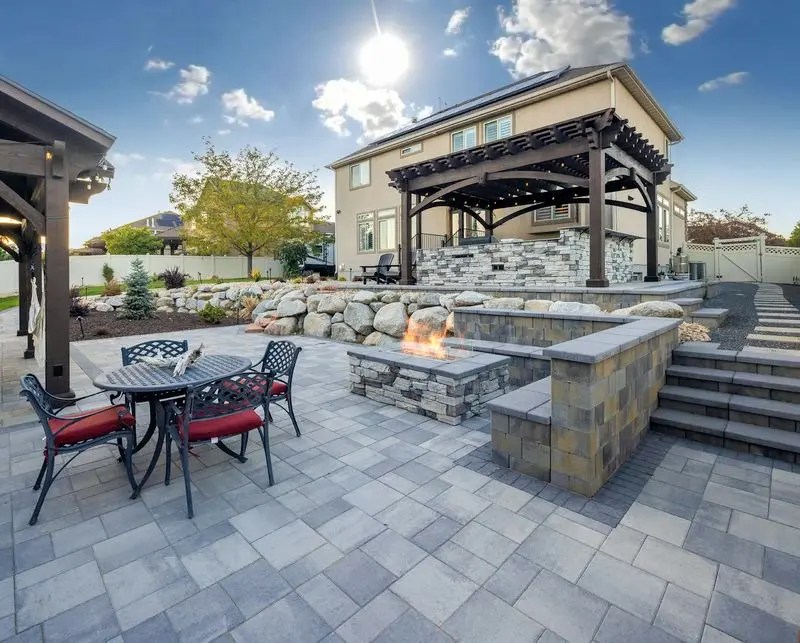
When Chopper Landscaping designs fire feature zones, wind direction and prevailing wind patterns are part of the site analysis. The combination of a fire pit, surrounding seating wall, and a pergola overhead creates a heat environment that performs dramatically better than a free-standing fire pit on an open patio.
Stunning Outdoor Spaces in Utah! 🌿✨
At Chopper Landscaping, we design and build stunning, functional outdoor spaces. From hardscapes to outdoor lighting and kitchens, we bring your vision to life.
Fire Pit Size and Configuration
Larger fire features produce more radiant heat. A 48-inch round fire pit produces approximately 40% more radiant surface area than a 36-inch round pit — and the heat output scales proportionally.
Linear fire features — longer and lower than round pits — project heat along a wider front, which works better for rectangular patio layouts and long seating walls than a single round pit.
Fire Media and Flame Height
Gas fire features are often paired with glass, lava rock, or fire log media. The media absorbs and re-radiates heat. Fire glass, in particular, absorbs flame heat and re-radiates it as radiant warmth across a wider angle than a flame-only burner.
Chopper Landscaping’s Fire Feature Designs
Chopper Landscaping has designed and built fire pit zones throughout Utah County — from custom built-in round fire pits with natural stone surrounds to linear gas fire features set in seating walls. The UNLA award-winning backyard we built in 2026 incorporated a fire zone designed to serve the multilevel patio’s entertaining function.
Every fire feature we design is:
- Sized for the seating zone — BTU output matched to the number of people and seating distance in the specific patio layout
- Wind-analyzed — positioned and oriented relative to prevailing winds with enclosure elements where appropriate
- Integrated into the patio design — the fire feature, seating wall, and surrounding patio area are designed as one zone, not as individual elements placed separately
- Built with a craftsmanship warranty — our masonry and gas connection work is covered by the same warranty as every other element we build
Our craftsmen have averaged 15+ years of experience building outdoor fire features in Utah’s climate. We’ve been doing this since 2018. We know what works here.
Frequently Asked Questions
Will a fire pit give off enough heat for my patio? Yes — a properly sized gas fire pit (60,000–80,000 BTU) comfortably warms 6–10 people at 5–7 feet in Utah’s shoulder-season temperatures.
How many BTUs does a fire pit produce? Gas fire pits: 40,000–150,000 BTU depending on burner size. Wood-burning: variable, can exceed 100,000 BTU with hardwood fuel.
Gas vs. wood-burning: which produces more heat? Wood-burning produces higher peak heat. Gas produces more consistent, controllable output. Many Utah homeowners install both for different uses.
How far should you sit from a fire pit to feel warm? 4–8 feet from the fire face. 5–6 feet is the sweet spot for most people at temperatures above 35°F.
What size fire pit do I need for my Utah patio? For 6–10 people: 36–48 inch gas pit at 60,000–80,000 BTU. For 10–15 people or windy exposures: 60,000–120,000 BTU linear feature.
Design Your Fire Feature Zone With Chopper Landscaping
A fire pit is more effective when it’s designed as part of a complete outdoor zone — right size, right position, right seating layout, right enclosure. Chopper Landscaping designs fire feature zones that actually work in Utah’s climate, backed by 8 years of experience and a craftsmanship warranty on all construction.
📍 Serving Utah County, Salt Lake County & the Wasatch Front | Sustainable practices. Beautiful outcomes.


